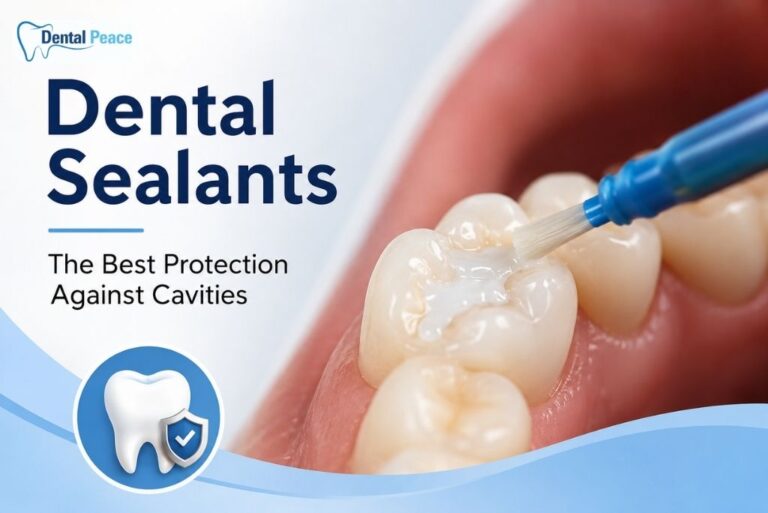
Dental Sealants: The Best Protection Against Cavities
Decay is one of the most rampant dental issues facing our global community, affecting those from childhood to adulthood. While daily brushing and flossing are considered basic care, the truth is that such a regimen cannot cover every part of your teeth’s sensitive surfaces. An excellent solution, dental sealants establish a protective barrier over your back teeth using clinically proven methods.
What Are Dental Sealants?
A dental sealant is a clear, plastic coating that a dentist applies to the chewing surfaces of your back teeth. Because the anatomy of these teeth includes deep fissures, food and bacteria have a tendency to become lodged within these cavities, and sealant forms a protective barrier for the tooth to keep cavity-causing bacteria from getting in. it is necessary to maintain overall oral hygiene.
How Do They Work?
Your back teeth consist of chewing surfaces that a dentist uses to determine the extent of your tooth decay. The same chewing surfaces that enable you to process your food are also ideal hiding spaces where bacteria and food accumulate.
Because the crevices of the tooth’s chewing surfaces are so narrow, your regular toothbrush can’t get deep enough into them.
When dental sealants are applied, they prevent bacteria from entering and creating a cavity, sealing off all access points to your tooth. Their application decreases tooth decay in your back teeth by 80%.
Who needs sealants?
Children aged 6-14 can be great candidates since this is the time when their permanent molars erupt.
Sealants are ideal for keeping your teeth healthy during childhood, the age when teeth are most prone to decay.
Children who had sealants were 3 times as likely to have cavities compared to children who didn’t.
Teens and adults can have sealants placed on their molars if they have deep pits and fissures in the chewing surfaces.
Sealants can be applied to anyone as long as they do not already have a cavity or a filling on their back teeth.
Baby teeth can also have sealants placed if they contain deep pits and fissures to keep them developing in a way that prepares them for future permanent teeth.
They first scrub your teeth thoroughly so that they are clean and free of debris and bacteria. Thereafter, your teeth are completely dried, and a special solution containing acid is used to slightly roughen the surface of your teeth. This aids the bond of the sealant.
Your dentist then rinses and dries the tooth surface again before painting your tooth surface with the sealant material. The protective coating is hardened instantly with a special curing light. The entire process is quick, painless, and there is no recovery time.
Benefits of Sealants
They target your vulnerable spots. Sealants prevent the development of decay on the more difficult to clean surfaces that traditional tooth brushing fails to cover.
Sealants are affordable: Fillings, root canals, and crowns are considerably more expensive than dental sealants.
No downtime: You can resume all normal activities, including eating and drinking, immediately after your sealant procedure.
They are easy to care for: You will need to avoid chewy, sticky, or hard food products to allow your sealant to cure and prevent it from dislodging.
Final Thoughts
Dental sealants are an excellent option for preventing tooth decay. They can serve as a critical component of a complete dental care regimen, when coupled with regular oral hygieneand professional dental check-ups and maintenance, which helps ensure your long-term oral health.
Don’t let cavities get a stronghold in your back teeth. Schedule a consultationwith Dental Peace today to discuss whether dental sealants would be ideal for you!
Location:
C2/252, Kundapura, C-2 Block, Janakpuri, New Delhi, Delhi, 110058