Professional Tartar Removal for Better Oral Hygiene
Most people brush and floss, kind of faithfully, yet still end up seeing that yellowish-ish stuff show up along the gumline. That stubborn covering is tartar, and it doesn’t matter how much you scrub at home, once it hardens. If you understand what tartar is, why it appears, and how a professional actually performs tartar removal, you can make a real difference in your long-term oral health.
What Is Tartar and How Does It Form?
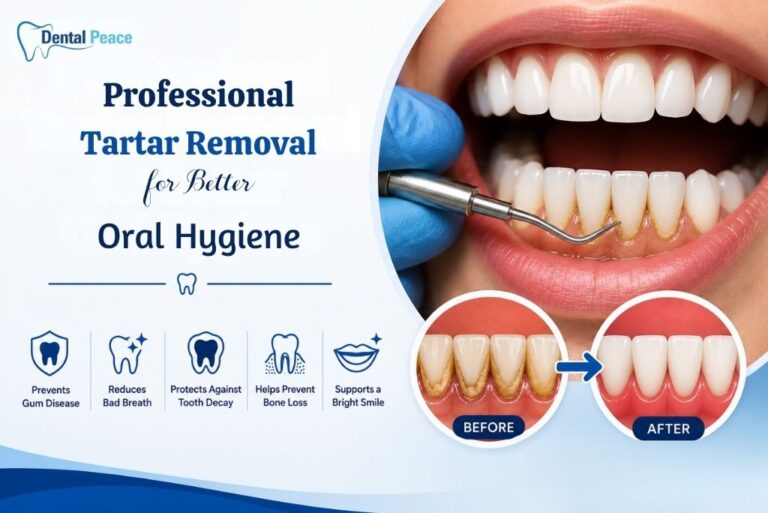
Tartar, also known as dental calculus, is hardened dental plaque. Plaque is a sticky, colourless bacterial film that keeps building up on teeth, day after day. If you don’t wipe it away with routine brushing and flossing, minerals from your saliva start to fuse with the plaque, and it calcifies into tartar usually within 24 to 72 hours.
Unlike plaque, tartar is very hard to remove and adheres firmly to the surface of the tooth, both above and below the gum line. Does not liven up at home. The only way to remove the tartar safely is if it’s a trained dentistor dental hygienist who has specialised instruments.
There are individuals who are more likely to get a substantial buildup than others. Risk factors include:
Brushing and flossing are not done often, or are just done the wrong way
A diet loaded with sugars, refined carbs, and acidic foods
Smoking, or any tobacco habit
Dry mouth, which messes with saliva’s natural scrubbing and cleansing role
Wearing orthodontic appliances that basically get food trapped in little corners and spots
Why Tartar Removal is important for Oral Health
Tartar can lead to major oral health issues. Tartar is a big problem with your teeth.
With the accumulation of tartar, a whole chain of events occurs that goes beyond the look. As it irritates the surrounding gum tissue, tartar will cause inflammation. When left untreated, the first stage (gingivitis) can develop into full-blown periodontitis, where the gums begin to pull away from the teeth, and the pockets become deeper and deeper as bacteria grow and multiply unhindered.
If left untreated, tartar can cause:
One of the most common reasons for adult tooth loss is gum disease.
Gum disease: One of the leading causes of adult tooth loss
Decay: Tartar starts to wear away the enamel, making teeth susceptible to decay.
Bone loss: As the gum infection worsens, the supporting bone can be lost.
Bad breath: Bacteria in the tartar pockets release compounds that cause bad breath.
Tartar collects pigments from coffee, tea, and tobacco, stains them over time, and turns them brown or black.
When tooth loss has already occurred as a result of gum disease, find out what your choices are for tooth restoration to restore your smile.
The process of Professional Tartar Removal
The professional tartar removal procedure is a dental scaling and uses either handheld scalers or ultrasonic instruments, which vibrate at high frequencies, in order to clean the surfaces of the teeth and under the gums of hardened deposits. It’s a comprehensive and secure method when handled by a trained person.
An intensive treatment called scaling and root planing may be recommended if the oral pockets are deeper, as a result of existing gum disease. This deep cleaning will help to remove infected tissue, smooth out the surface of the root, and make it more difficult for the bacteria to reattach.
After scaling, the hygienist will most likely polish the teeth to smooth their surfaces and make them less prone to future plaque buildup, and to remove any surface stains.
Once you’ve had a deep clean, the surface discolouration as a result of tartar can leave you less than pleased with your smile; however, professional stain removal and whitening care can assist in bringing back brightness to your smile.
Final Thoughts
Although tartar is a process that cannot be reversed, it can be prevented, and if it does occur, only professional help is safe for tartar removal. The removal of any hidden deposits at home can cause damage, injury to the gum tissues, and further damage to the enamel from the scraping.
Backed by expertise, Dental Peace offers in-depth dental cleanings, gum disease care, and customized suggestions for oral health.
Location:
C2/252, Kundapura, C-2 Block, Janakpuri, New Delhi, Delhi, 110058