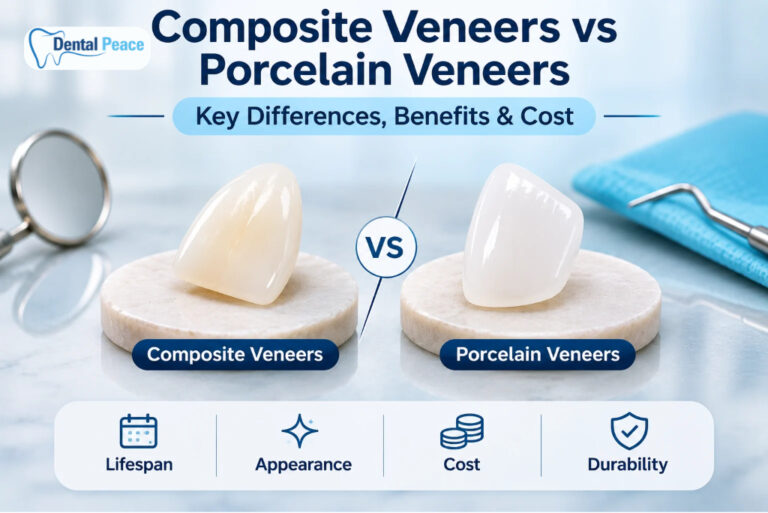
Composite Veneers vs Porcelain Veneers: Key Differences, Benefits & Cost
Want a brighter, more even smile without a long dental journey? Veneers can hide chips, stains, and small gaps quickly. But when you’re stuck choosing between Composite Veneers vs Porcelain Veneers, things get confusing fast. They look similar at first glance, yet they differ in price, strength, and lifespan. Here’s a simple, friendly breakdown- no jargon, just clear and honest answers- so you can pick what truly suits your teeth, your habits, and your pocket. Let’s dive in.
What Exactly Are Veneers?
Think of veneers as thin shells that sit on the front of your teeth. They cover cracks, stains, and uneven edges. Your dentist shaves off a tiny bit of enamel first, then bonds the shell in place.
You’ll usually hear about two types:
Composite resin:a tooth-colored material shaped right on your tooth.
Porcelain:a thin ceramic shell made in a dental lab.
Most dentists plan veneers as part of smile design, so the shape, shade, and size all match your face.
Composite Veneers vs Porcelain Veneers: Key Differences
The biggest difference is how they're made. Composite is built up on your tooth, usually in one sitting. Porcelain takes two or more visits because a lab makes it.
Lifespan:Composite lasts roughly 4 to 7 years. Porcelain can go 10 to 15 years.
Stains:Porcelain shrugs off tea, coffee, and wine. Composite can darken over time.
Look:Porcelain bounces light like real enamel. Composite can lose its shine.
Repairs:A chipped composite veneer is a quick fix. Porcelain usually needs replacing.
Benefits You Should Know About
Composite is easy on your wallet and removes less enamel. It’s great when a wedding or big event is around the corner. Many people compare Composite Veneers vs Porcelain Veneers by price alone, but there’s more to it.
Porcelain gives you a longer-lasting, very natural finish. It feels smooth and stays bright for years.
Composite Veneers vs Porcelain Veneers Cost in India
Prices vary by clinic, city, and how many teeth you treat. Here's a rough idea:
Composite:about ₹3,000 to ₹8,000 per tooth.
Porcelain:about ₹10,000 to ₹30,000 per tooth.
Porcelain costs more upfront but needs fewer repairs. Composite looks cheaper now, yet replacements add up. Dental Peace shares clear treatment plans and EMI options, so there are no nasty surprises. A dental consultation in Janakpurican give you an exact quote.
How to Pick the Right Option
Start with your goals. Ask yourself three simple things:
How long should the results last?
What budget feels comfortable?
Do I grind my teeth or chew hard foods?
If you want a quick, budget-friendly change, composite may do the job. If you want a long-term upgrade, porcelain usually wins. Your choice between Composite Veneers vs Porcelain Veneers also depends on gum health.
So, which one should you choose? If you want speed and a lower cost, composite works well. If you want durability and a natural glow, porcelain is the better bet. Whatever you pick, get a proper check-up first. At Dental Peace, Dr. Devika Duggal and her team can guide you through Composite Veneers vs Porcelain Veneers at their Janakpuri and Kailash Colony clinics. Book a visit, ask everything, and walk out with a plan that fits.
Location:
C2/252, Kundapura, C-2 Block, Janakpuri, New Delhi, Delhi, 110058